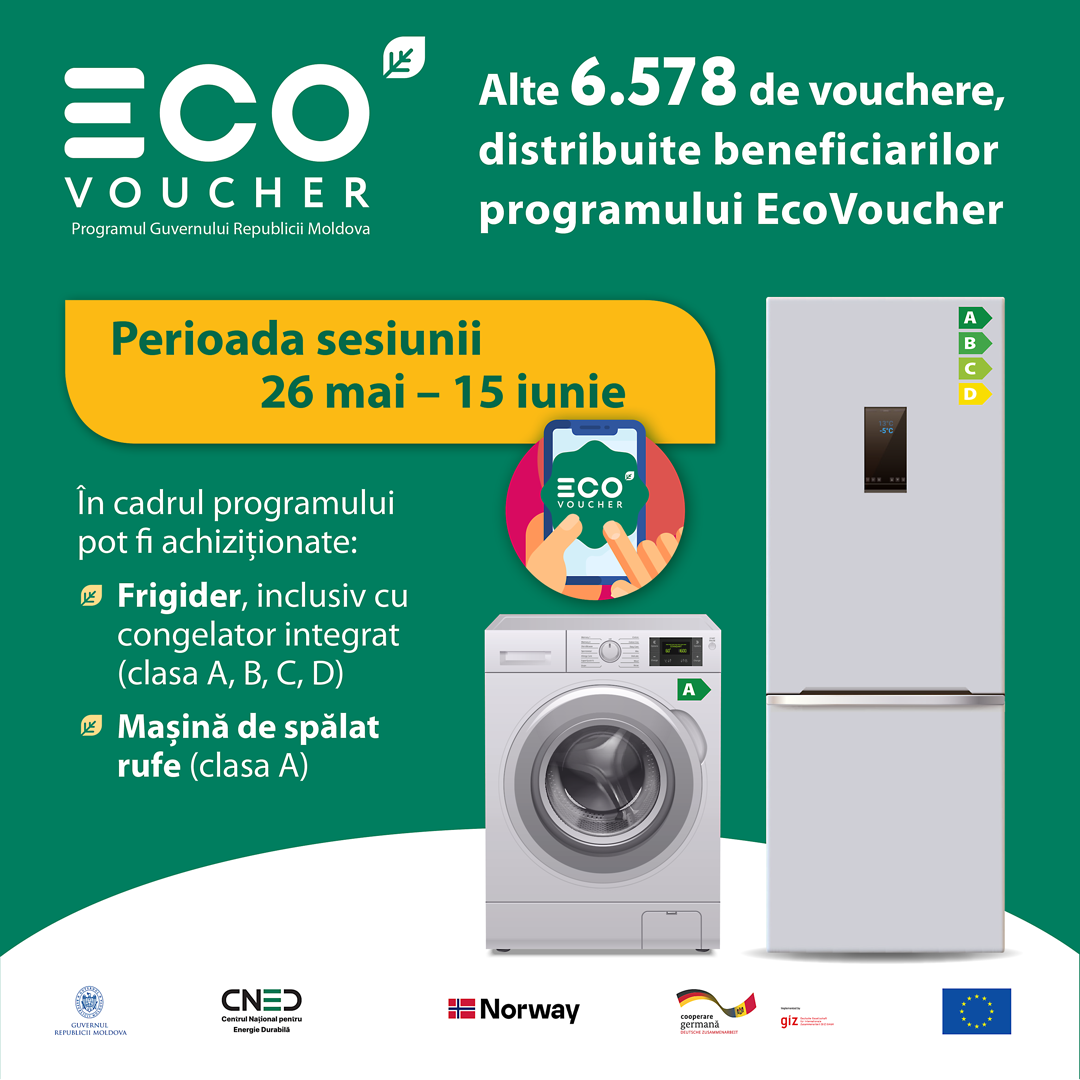
The EcoVoucher Program continues to help families in the Republic of Moldova replace old, energy-consuming appliances with energy-efficient ones. An additional 6,578 vouchers have been made available to households across the country with the launch of the new session, taking place between May 26 and June 15.
The vouchers, worth 6,000 MDL, are distributed in consecutive rounds based on household data submitted via the platform compensatii.gov.md. Priority is given to families with many children and those with two or three elderly members over the age of 63. Notifications are sent via SMS from GOV1.MD, email, or directly to the applicant’s personal account. The voucher is valid only during the active session period and can be used exclusively in the partner store network to purchase refrigerators (including those with integrated freezers, classes A, B, C, and D) and washing machines (class A) that meet energy efficiency criteria and European Conformity (CE) standards. The vouchers can be redeemed in 8 partner retail chains, comprising over 80 sales points nationwide. A key condition of the program is that beneficiaries must co-pay for the new appliance and hand over an old appliance of the same type for recycling.
“Designed during the energy crisis, when international prices reached record levels, this program offers a long-term solution to reduce household energy bills and to meet national objectives in reducing energy waste and greenhouse gas emissions. We can achieve these ambitious goals, and we thank our development partners for their support,” stated Dorin Junghietu, Minister of Energy.
“The EcoVoucher Program is increasingly being seen not just as a social support tool, but as part of a broader transformation in everyday consumption practices. We are witnessing growing interest in energy efficiency and a trend among families to consider the long-term benefits of saving resources,” said Ion Muntean, Director of the National Center for Sustainable Energy (CNED).
“For Norway, supporting vulnerable households in the Republic of Moldova is a priority. We are proud to see that the EcoVoucher Program is having a meaningful impact on families’ lives while also promoting social equity and sustainability in the energy sector,” stated Kamilla H. Kolshus, Chargé d’Affaires at the Norwegian Embassy Office in Chișinău.
“EcoVoucher demonstrates both stability and potential for expansion. The growing network of partners, increased engagement, and public awareness show that the program has become a sustainable mechanism capable of further development,” added Christian Borchard, implementation manager of the E4M component at GIZ.
In the current edition of the program, financed by Norway, up to 32,000 families are expected to receive support. In the first two rounds this year, more than 10,600 households received financial assistance to purchase new energy-efficient appliances, and since the launch of the program, over 25,000 families have replaced an old appliance through EcoVoucher.
Details about the program, instructions on how to use the voucher, and a list of partner stores are available at: www.ecovoucher.md.
Voucher availability can be checked at: verificarevoucher.cned.gov.md. Beneficiaries can also get more information via the CNED Green Line: 0 8005 5005 or email: info@ecovoucher.md.
The EcoVoucher Program was developed by the Government of the Republic of Moldova with the support of the European Union.
This edition of the Appliance Voucher Program is implemented by the National Center for Sustainable Energy under the project “Energy Efficiency and Renewable Energy for Moldova” (E4M). E4M is a project implemented by GIZ in partnership with the Government of the Republic of Moldova, financed by the Government of Germany and co-financed by the European Union, Norway, and Denmark. The current edition of the Appliance Voucher Program is funded by Norway.
The National Center for Sustainable Energy (CNED) is a public institution under the Ministry of Energy responsible for coordinating and organizing activities aimed at implementing state policies in its fields of operation, including through the attraction and management of financial resources to fund and promote projects and programs in a sustainable manner—environmentally, climatically, and in support of enhancing the country’s energy security.