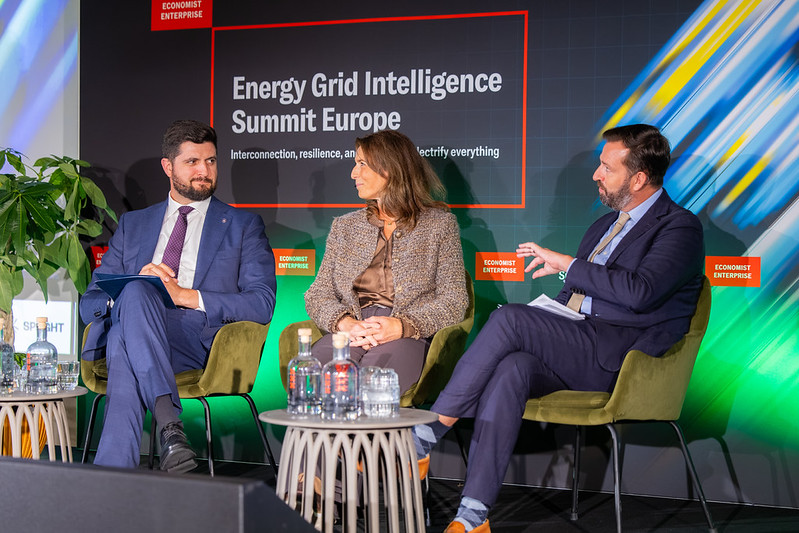
“Europe needs not just more grids, but a more extensive network”: Dorin Junghietu presents Moldova’s energy infrastructure priorities in Amsterdam
- 156 reads


The experience of the Republic of Moldova, which has effectively rebuilt its energy security architecture in recent years, was presented in Amsterdam at the Energy Grid Intelligence Europe Summit, organized by The Economist. Minister of Energy Dorin Junghietu spoke at the event alongside representatives of European institutions, transmission and distribution system operators, energy companies, and experts in infrastructure and energy security.
During his address, the minister shared the lessons Moldova had learned from several crises and outlined the measures taken to reduce the country's dependence on a single energy supplier or supply corridor. Dorin Junghietu reiterated that energy resilience cannot be built solely through responses to crises, but requires planned investments in networks, equipment, generation and storage capacity, as well as human resources.
“Moldova has a small energy system, but in recent years it has faced almost every possible stress test: Russian attacks, extreme weather events, and regional drought. We have made it through all of them without a widespread interruption of supply. However, resilience built solely on solidarity and goodwill cannot be a long-term strategy. We need infrastructure, cables, transformers, equipment, and trained people,” said Minister of Energy Dorin Junghietu.
One of the central topics of his address was the development of interconnections. In this regard, the Republic of Moldova is transitioning from dependence on a single main import corridor towards building a more diversified network of interconnections with Romania.
The minister also stressed that energy infrastructure development depends not only on investments in major projects, but also on qualified professionals capable of designing and building strategic infrastructure projects on schedule, as well as operating and maintaining the new networks. The Republic of Moldova aims to modernize its transmission system operator, Moldelectrica, including through the modernization of SCADA/EMS systems, the rehabilitation of 120 electrical substations, the development of balancing services, and the strengthening of new market mechanisms. In this context, training specialists is particularly important, Dorin Junghietu noted.
“Every kilometre of a 400 kV transmission line requires engineers, intervention teams, substation specialists, project managers, and qualified personnel. For a small country, competition for these people is not merely national but regional. That is why we need cooperation between system operators and joint training programmes. Our teams cannot develop all the skills we need on their own,” the minister said.
Regarding domestic energy generation, the minister emphasized that the Republic of Moldova is not yet energy self-sufficient and does not intend to isolate itself. Its objective is to reduce exposure to external risks. Installed electricity generation capacity from renewable sources has exceeded 1 GW, while the development of energy storage systems represents the next important step towards improving the flexibility of the energy system.
Dorin Junghietu also highlighted Ukraine's role in the regional energy security architecture. The Republic of Moldova already has important electricity interconnections with the Ukrainian system, and maintaining and developing these connections provides alternative routes in the event of outages and contributes to the resilience of the entire region.
During his visit, Dorin Junghietu also participated in the Energy Grid Leaders’ Club, a closed-door forum bringing together approximately 50 senior representatives of transmission and distribution system operators and authorities responsible for energy policy. The minister also met with Damian Cortinas, Chair of the Board of the European Network of Transmission System Operators for Electricity (ENTSO-E). Discussions focused on the development of Moldelectrica, which has been an ENTSO-E observer member since 2024, and the steps needed to advance the process of full integration into European structures.
The Energy Grid Intelligence Europe Summit, organized by The Economist, focused on one of the key challenges facing Europe's energy transition: the continent's ability to plan, authorize, and build transmission infrastructure much faster and on a much larger scale. The development of grids and interconnections is essential not only for integrating new generation capacity, but also for industrial competitiveness, the growth of data centres and artificial intelligence, and energy security in the face of climate-related, cyber, and geopolitical risks.
In this context, the Republic of Moldova's experience brings a first-hand perspective to the European debate on the cost of delays in infrastructure development and the need for predictable access to financing, equipment, and construction capacity.
“Europe does not need just more grids, but a more extensive network. The Republic of Moldova is ready to build networks. What we need now is predictable financing, access to equipment, and people who can turn projects into operational infrastructure,” Dorin Junghietu concluded.
Images