How Has the Energy Sector Transformed with the Boost of Renewable Energy? (Article)
- 1067 reads


Over the past five years, Moldova’s installed renewable energy capacity has increased more than tenfold, from 76 MW in 2020 to 784 MW by the end of July 2025. At this pace, the Ministry of Energy’s plans to reach 2,600 MW of wind power and 1,200 MW of photovoltaic capacity by 2050 no longer seem unattainable.
Accelerated Integration of Renewables
The rapid integration of renewable sources has been made possible both by government-led reforms and renewable support mechanisms (guaranteed-price contracts, net metering, fixed tariffs and prices), as well as favorable market conditions that allow investment recovery in a relatively short period. About half of commercially installed renewable power plants now sell electricity in the competitive market, without any state support mechanisms.
Major Reforms Driving Renewable Expansion
Key reforms supporting renewable development include the simplification of administrative procedures through amendments to the Land Code, allowing the construction of photovoltaic power plants on agricultural land without requiring a change in land use. This removed a major bureaucratic obstacle and will further support the expansion of renewable capacity.
The use of Guarantees of Origin (GoOs) has also been expanded, preparing Moldova for integration into the European system. Moldovan producers can demonstrate the green origin of their energy and sell it on broader markets. They can also earn additional revenue from trading GoOs, while consumers can verify sustainability standards and the “green” origin of energy. GoOs are issued for electricity from renewable sources, low-carbon gases including hydrogen, or heating and cooling from renewable sources.
Additionally, the first tender for renewable energy production at fixed prices was launched. Local and international companies committed to building 165 MW of wind and solar plants, investing around €190 million. All photovoltaic plants have now been constructed and commissioned, with Energocom, as the central electricity supplier, either purchasing the generated electricity or securing stable revenues through 15-year contracts for differences.
Synchronization with the Continental Grid Was a Game-Changer
The most significant event encouraging these reforms was the synchronization of Moldova’s energy system, together with Ukraine, with the European ENTSO-E grid. Previously, Moldova was synchronized with the Russia-Belarus system (the IPS/UPS zone), which included Ukraine and the Baltic states. A synchronous operation test was planned for the night of February 24, 2022, when Russia invaded Ukraine—demonstrating how vulnerable energy systems are in times of crisis.
Following emergency synchronization on March 16, 2022, within three weeks Moldova’s electricity transmission operator Moldelectrica became an observer in ENTSO-E, and Ukrenergo became a full member on January 1, 2024. Moldova still needs to adopt European operational standards, including protection systems and frequency regulation by Moldelectrica, to become a full member, but the synchronization had a major impact: it opened access to the European electricity market and enhanced national energy security.
After synchronization, Moldova could import electricity from Romania or any EU country, reducing dependence on the Moldovan power plant MGRES in Transnistria, controlled by a Russian company. By the end of 2025, with the completion of the Vulcănești–Chișinău connection, electricity from Romania will no longer pass through MGRES, eliminating dependence on Transnistria and any external technical or political influence.
Previously, about 70% of electricity came from MGRES. After 2022, Moldova could no longer be blackmailed with high prices or supply cuts, and now around 60% of consumed energy comes from Romania. The rest comes from local cogeneration and renewable sources, which are breaking new records. In June 2025, 36% of consumed energy came from renewables, and at certain hours, renewable generation covered the country’s entire demand.
How to Balance the Grid and Integrate More Renewables
The main challenge in integrating large amounts of renewable energy is their intermittency—they depend on weather conditions—and consumption patterns. About half of energy is consumed by households, mostly in the morning and evening when solar panels are less productive.
Flexible natural gas plants are therefore necessary to cover baseload demand and provide immediate support when renewable generation drops. These plants, combined with battery storage systems, can quickly respond to fluctuations in renewable output.
Currently, grid balancing relies on imported energy from Romania and Ukraine. In the fall, Moldelectrica plans to organize tenders to independently contract balancing and system services. The new tender for 173 MW of wind farms will also include battery storage to support grid stability.
Two additional connections with Romania—Bălți–Suceava and Strășeni–Gutinaș—will increase import/export capacity and ease grid balancing. Bălți–Suceava is in the bidding phase and expected to be completed by 2027, while Strășeni–Gutinaș is still seeking funding after USAID project cancellations.
From July 2025, Moldova’s commercial import capacity from ENTSO-E is calculated monthly, ranging from 1,350 to 2,100 MW for the Ukraine–Moldova frequency-power block (only 15% allocated to the Vulcănești–Isaccea interconnection). With more interconnections to Romania, Moldova’s allocation will increase. According to the 2050 Energy Strategy, interconnection capacity is projected to reach 780 MW by 2030 and 2,000 MW by 2050.
How Is Electricity Imported?
Importing electricity from Romania requires more than finding it on the market. Energocom, as a public service provider, must reserve sufficient transmission capacity along with other traders and importers. Capacities are allocated through auctions—annually, quarterly, daily, or hourly.
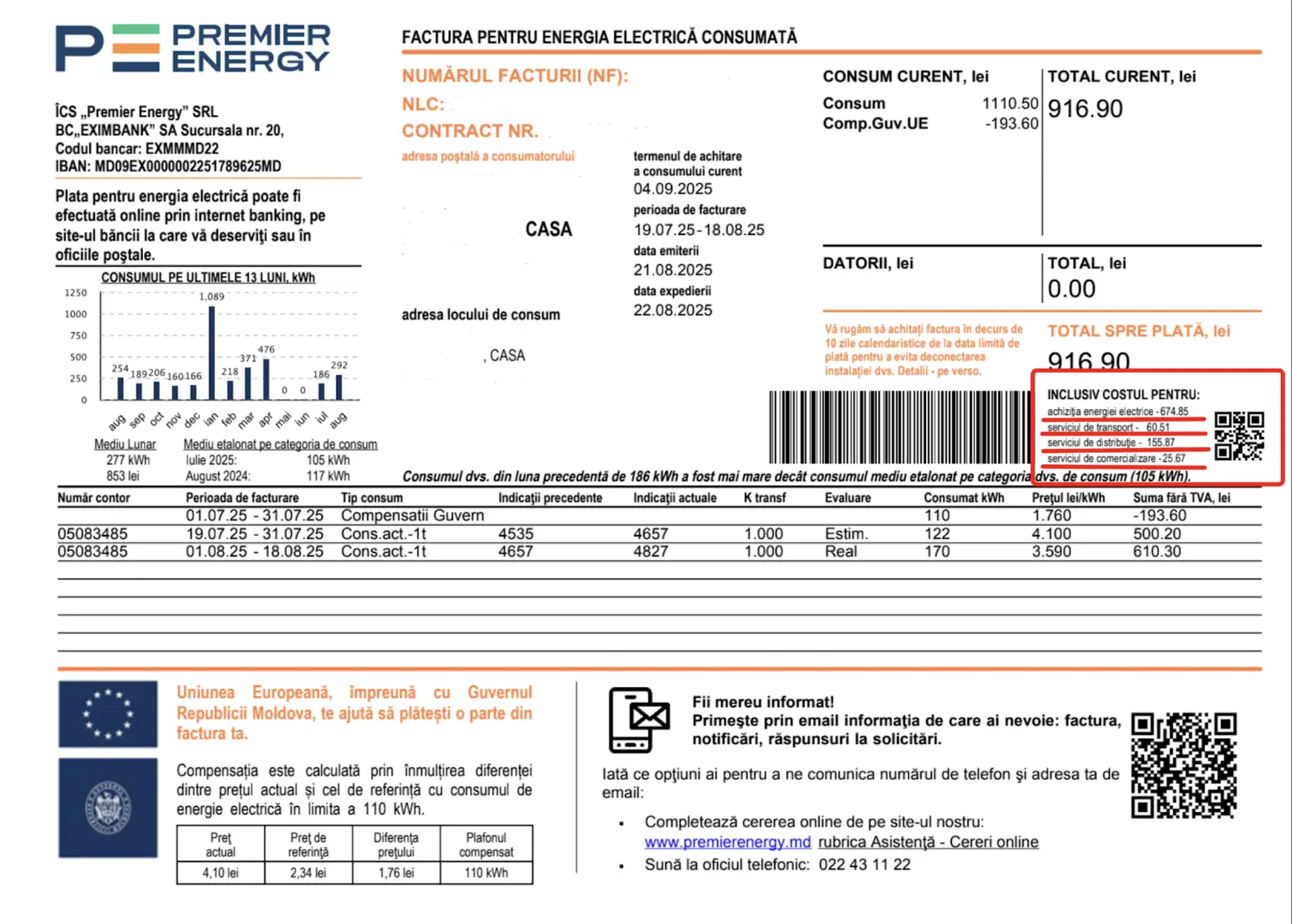
The liberalization of the energy market has also changed the structure of market players. Unbundling of supply, transport, and distribution led to new types of companies. Suppliers buy electricity on the wholesale market, contract with end consumers, invoice them, and ensure service quality. They also have contracts with transmission and distribution operators. Moldelectrica manages high-voltage networks, while Premier Energy Distribution and RED-Nord manage medium and low-voltage networks to end consumers. Regulated tariffs are itemized on bills, showing transport, supply, and distribution costs.
Market Liberalization and Consumer Benefits
Market liberalization allows consumers to change suppliers for better prices. With short-term markets, OPEM will provide reference price signals, enabling differentiated tariffs for different times of day. Meanwhile, the energy sector is being digitized. With UNDP Moldova and the Italian government’s support, a pilot project installs 100,000 smart meters, measuring consumption in 15-minute or hourly intervals, enabling time-of-use tariffs and influencing consumption behavior. The program will later expand nationwide.
The ambitions of these reforms, strongly supported by development partners, especially the EU, are high. According to the Energy Strategy, by 2030 at least 31.2% of electricity consumption will come from renewables. By 2050, over 80% of local electricity production and over 90% of final electricity consumption will come from local renewable sources.
The energy sector involves high costs for infrastructure construction and maintenance, as well as resource procurement, which accounts for 60–80% of the final bill. Yet the importance of energy lies not in the physical assets but in the value it creates for consumers—light, heat, the ability to cook, and access to the internet and communication.
Vitalie Condratchi
Images