Republic of Moldova praised by the European Commission for progress in the energy sector
- 1327 reads

The Republic of Moldova has made remarkable progress in the energy sector, and the European Commission highlights these achievements in its 2025 Annual Report on the Progress of EU Candidate Countries. In particular, our country was recognized for advancements in Chapter 15 – Energy and Chapter 21 – Trans-European Networks, key areas for European Union accession.
According to the Report, Moldova’s substantial reforms in transposing and implementing the EU energy acquis represent major progress in the EU accession negotiations.
In the energy sector, Moldova has gradually eliminated its dependence on the thermal power plant in the Transnistrian region by switching to electricity imports from Romania. Natural gas, procured on the market and stored in Ukraine and Romania, has covered the country’s consumption needs for the winters of 2023–2024 and 2024–2025.
Moreover, the Commission highlighted amendments to the Gas Law, which require mandatory storage of natural gas equivalent to at least 15% of the average annual consumption. A framework has also been established for liberalizing the natural gas market and gradually reducing public service obligations for large industrial gas consumers—a process initiated in October and expected to be completed by April 1, 2026, according to the National Energy Regulatory Agency (ANRE).
The report also notes the successful completion of the unbundling of natural gas transmission and supply activities in accordance with the EU’s Third Energy Package.
The Report highlights progress in the domestic energy market, including the adoption of the Electricity Law, aligned with the EU Electricity Market Integration Package, and the harmonization of the Tax Code with EU legislation regarding the reverse charge mechanism for electricity and natural gas.
Regarding renewable energy, the European Commission commended the implementation of tenders for large-scale renewable (60 MW) and wind (105 MW) projects, as well as the organization of the second round of tenders (173 MW), which will provide not only wind capacity but also energy storage, supporting the green energy transition.
The Commission welcomes amendments to the Energy Law in line with the EU Regulation on Governance of the Energy Union and Climate Action, as well as the approval of the Integrated National Energy and Climate Plan to achieve the country’s decarbonization goals and commitments.
The Report also highlights progress in energy efficiency through the reorganization of the Energy Efficiency Agency into the National Center for Sustainable Energy (CNED), which manages energy efficiency projects in public and residential buildings.
The Report further notes that Moldova has begun aligning with European standards for nuclear energy and radiation protection, and legislation has been amended to comply with EU regulations on Energy Union governance and trans-European energy infrastructure.
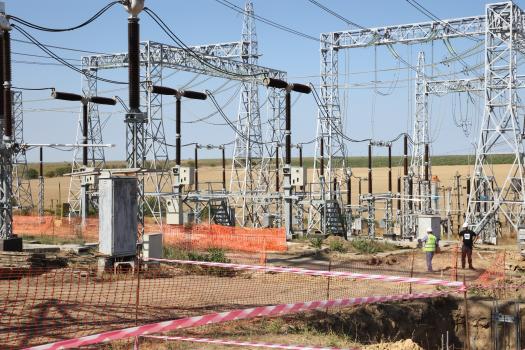
In the field of trans-European networks, the report emphasizes that “infrastructure projects need to be accelerated to reduce Moldova’s vulnerability and improve interconnection with neighboring countries.” In this context, the document mentions Moldova’s progress in developing regional electricity connections, including the construction of the Vulcănești–Chișinău 400 kV, Bălți–Suceava, and Bălți–Dniester Hydropower Plant (Ukraine) 330 kV lines.
The Report concludes that Moldova’s substantial progress in transposing and implementing the EU energy acquis demonstrates the country’s ability to build an integrated, European-aligned energy future.
Images